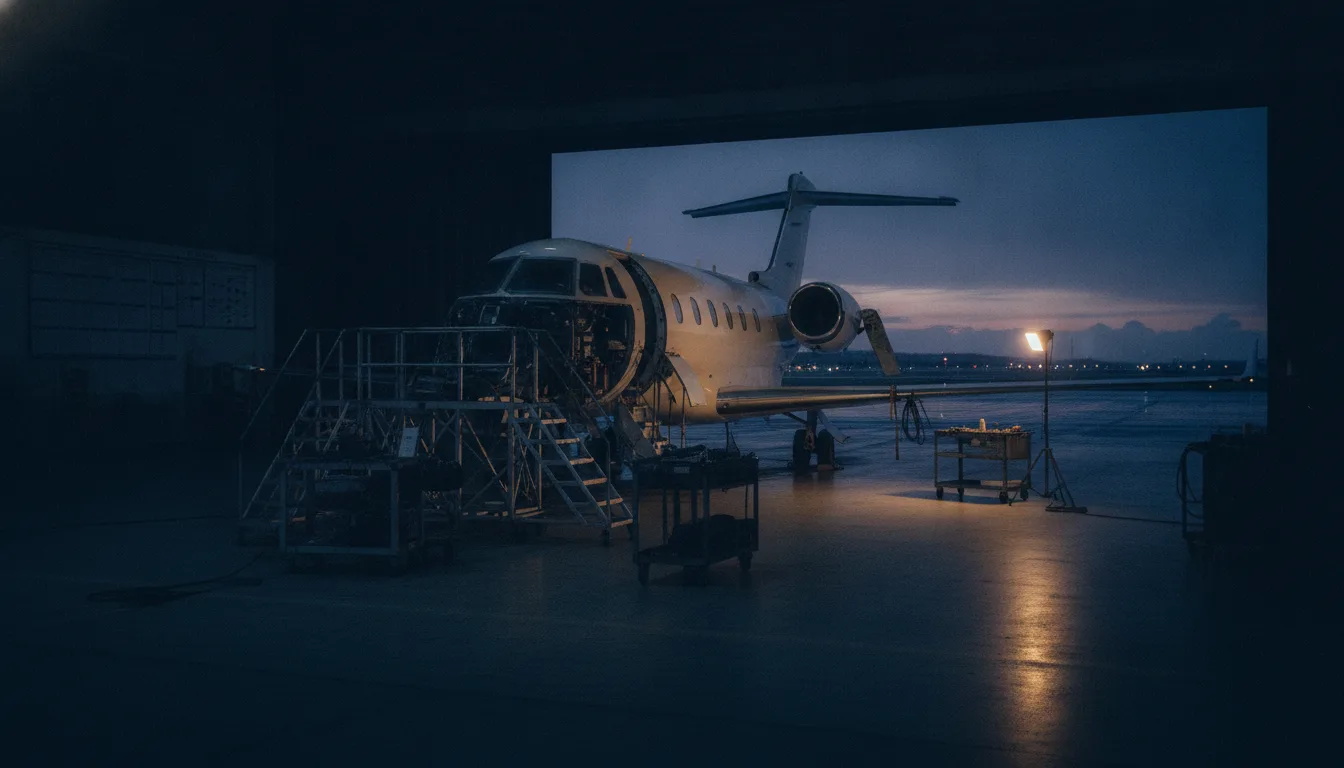
Two bids come back on the same written scope for a midsize jet. Shop A: $268,000, and they want the aircraft for twenty four days. Shop B: $291,000, fifteen days.
Most operators take Shop A, because it is twenty three thousand dollars cheaper and that number is printed on the page in a font you can read. The nine day difference is the actual decision in front of you, and almost nobody prices it before choosing.
This article is about pricing it properly, which turns out to be more interesting than it sounds, because the answer changes depending on what month it is.
First, the calculation almost everybody gets wrong
You will see downtime cost expressed as lost revenue. A midsize aircraft billing $5,500 an hour, two hours a day, twenty four days, therefore $264,000 of lost revenue. Alarming, quotable, and wrong.
It is wrong in the direction that flatters the argument, which is why it survives. If the aircraft does not fly, you do not buy the fuel. You do not pay the landing and handling fees, the catering, the crew per diem, or the variable maintenance accrual on hours that were never flown. Fuel alone runs to roughly half of variable cost on a typical charter flight, and it is front loaded, since the climb burns more than the cruise.
The honest measure is contribution margin: the charter fee minus the variable costs of that specific flight. That is the money that would have gone toward covering your fixed overhead, and it is the money that actually did not arrive.
Now the correction in the other direction, which people miss just as often. Your fixed costs do not pause while the aircraft sits in somebody else's hangar. Crew salaries, hangar, insurance, training, and subscriptions continue at precisely the same rate. Industry commentary generally puts fixed costs at around 80 percent of the total annual expense of operating a mid size or large cabin jet, and every one of those dollars is now being spread across fewer revenue hours.
One more that catches operators out at year end. Hourly cost maintenance programs are quoted per flight hour, but many carry a minimum annual dollar commitment. Fly fewer hours and you still owe the balance. Downtime does not reduce that obligation. It simply removes the hours you were going to earn it back on.
Downtime does not cost you revenue. It costs you contribution margin while your fixed cost base keeps running at full speed.
Which gives you something you can actually calculate:
Daily downtime cost
(Expected billable hours per day x contribution margin per hour) + recovery costs
Recovery costs are the real cash you spend protecting the client relationship: subcharter to cover a trip you already sold, crew repositioning, and the occasional goodwill concession. Those are out of pocket, not opportunity cost, and they belong in the number at full value.
Working it through
Take a well booked midsize aircraft. The figures below are constructed to demonstrate the method rather than to describe any specific operation, but they sit inside published 2026 ranges.
- Blended charter rate of $5,500 per hour, which falls within the typical midsize band of roughly $4,300 to $7,000.
- Variable cost of about $3,000 per hour across fuel, landing and handling, crew expenses, catering, and hourly maintenance accrual.
- Contribution margin of $2,500 per hour.
- Annual utilization of roughly 500 charter hours, consistent with figures cited for high demand midsize aircraft in the range of 400 to 600 hours.
Five hundred hours across a year is not distributed evenly, and that is the whole point. In your strong months the aircraft might average close to 1.9 billable hours per day. In your trough it might average 0.6. At $2,500 of contribution per hour, a day of downtime costs you $4,750 in peak season and $1,500 in the slow season.
Run the two bids through that.
| Shop A | Shop B | |
|---|---|---|
| Quoted price | $268,000 | $291,000 |
| Quoted downtime | 24 days | 15 days |
| Ferry from home base | 2.1 hours each way | 0.6 hours each way |
| Schedule window | Approximate | Contractual, with remedy |
| Peak season: contribution at risk | $114,000 | $71,250 |
| Peak season: total economic cost | $382,000 | $362,250 |
| Slow season: contribution at risk | $36,000 | $22,500 |
| Slow season: total economic cost | $304,000 | $313,500 |
In peak season Shop B is roughly twenty thousand dollars cheaper despite quoting a higher price, and that is before counting the extra three hours of ferry time each way and before assigning any value to the fact that its schedule window is contractual rather than aspirational.
In the slow season the answer inverts. Shop A wins by about ten thousand dollars, and the nine extra days cost you very little because those days were not going to generate much anyway.
The bids did not change. The calendar did. Timing moved the answer by roughly thirty thousand dollars on a decision most operators make by comparing two numbers on two cover pages.
Which means scheduling is a bigger lever than bidding
This is the part worth taking away even if you never run a competitive bid in your life.
Most operators treat the maintenance calendar as a constraint handed down to them. Good ones treat it as a variable they control, within the limits the inspection intervals allow.
- Move heavy events into your own demonstrable trough. Not the industry's trough, yours. Pull your booking data by month for the last three years and find where your contribution per day actually collapses. It is frequently not where people assume, and it varies enormously by base and by client mix.
- Book the slot early. Slot availability drives when your event actually happens far more than anything else, and the shops with the best turn times fill their calendars first. An operator booking eight months out is choosing from a different set of facilities than one booking six weeks out.
- Combine events where the intervals permit. Every induction carries fixed overhead measured in days: getting the aircraft there, opening it up, closing it out, the operational check, and the paperwork. Two separate small events consume more calendar than one larger combined one.
When the cheaper bid is the expensive choice, and when it is not
Both directions are real, and the discipline is deciding which situation you are in before you look at the prices.
The cheaper bid usually costs you more when
- The event falls in your strong season, so every additional day carries full contribution.
- The ferry is long, which adds cost, crew duty, and typically a day on each end.
- The schedule window is soft, described with words like approximately or targeting rather than as a commitment.
- The shop has a history of scope growth, which you would only know if you had been tracking it.
The cheaper bid is usually correct when
- The event sits in your trough and the marginal day is genuinely cheap.
- The shop is close to base, so the ferry is trivial and your crew is not displaced.
- The window is firm and the facility has a track record of holding dates.
- The price delta is large relative to your daily contribution, which is exactly the case for lightly utilized aircraft.
The operational rule that follows: calculate your daily contribution figure first, before you open the bids. If you read the prices first you will anchor on them, and every subsequent piece of reasoning will quietly organize itself around defending the cheaper number.
What a firm schedule window is worth, and how to get one
Most quoted delivery dates are estimates wearing the clothes of commitments. That is not usually dishonesty, it is a shop being realistic about an event whose content is partly unknown. But it means the date on the quote and the date you can plan against are different things, and you are the one carrying that difference.
Ask for the window to be a quoted term rather than a verbal assurance, with a stated remedy attached. A remedy does not have to be a penalty clause, and pushing hard for one often gets you a padded date instead of a reliable one. It can be priority rework, a rate concession on overrun days, or simply an agreed escalation path with a named person.
Then understand what the shop needs from you in order to hold it, because a facility genuinely cannot commit to a date if the customer is the bottleneck:
- A complete scope before induction, so the event starts with the work defined rather than discovered.
- Long lead parts identified and staged before the aircraft arrives. In a market where some categories have been quoting twenty to forty weeks and beyond, this is frequently the difference between a fifteen day event and a forty day one.
- Fast discrepancy approvals. This is the one that is entirely inside your control and it is the most common cause of overrun that operators blame on shops. If each approval takes you three days, you are the schedule risk.
Two practical fixes for that last point: pre-authorize a dollar threshold below which the shop simply proceeds and reports, and name a single decision maker who is reachable within an hour and actually has authority. Downtime accrues while people look for somebody who can say yes.
How disciplined operators compress downtime
- Complete the scope up front. Findings will still occur, because that is the nature of opening an airframe, but a vague scope guarantees mid event discovery of things that were knowable in advance.
- Stage parts before induction against the known scope.
- Run parts sourcing in parallel during the event, so the aircraft is never sitting idle while one person works one broker in sequence.
- Require work in progress reports at least twice a week, with hours booked and percent complete against each task. A schedule slip found on day six is recoverable. The same slip found on day twenty is a delivery date.
- Track your own history by shop: quoted days against actual days, and quoted scope against final invoice. After four or five events you will know which facilities quote honestly, and that knowledge is worth more than any single negotiation.
If you operate a fleet, the math changes again
For a multiple aircraft operator, downtime cost is not a per aircraft number. It is a per fleet number, because coverage changes everything.
A down aircraft whose trips can be absorbed by another tail in your own fleet costs you the difference in aircraft economics and some scheduling friction. A down aircraft that forces you into subcharter costs you the full margin on those trips plus the uncomfortable experience of introducing your client to somebody else's cabin and somebody else's crew.
The practical consequence is a scheduling rule that is easy to state and frequently violated: do not put two aircraft of the same type into heavy maintenance in the same window. Same type means same missions, same clients, and no internal coverage precisely when you need it.
Pricing the whole event, not the quote
Everything above requires one input that most operators cannot get: a reliable downtime figure attached to each bid, stated as a term rather than mentioned on a phone call.
Event quotes through VHMX come back with the schedule window and the scope explicitly stated as quoted terms alongside the price, on the same axes across every bidder. That is what makes the comparison in this article possible at all. You cannot weigh nine days against twenty three thousand dollars if one shop gave you a date in an email and the other gave you a range in conversation.
Parts sourcing runs in parallel with the event rather than in sequence behind it, which addresses the single most common cause of an event running long: an aircraft sitting complete except for one bracket that nobody started looking for until it was needed.
And the comparison you receive shows the elements of total economic cost, not just the quoted price, because the quoted price was never the number you were actually deciding on.
VHMX is not a repair station and does not perform maintenance. We do not tell you what work your aircraft needs or when to schedule it. We make the commercial and schedule terms of competing bids visible enough that you can do this arithmetic before you commit, rather than after.
Sources and further reading: Clay Lacy Aviation, published guidance on charter contribution margin, variable cost composition, and fixed cost recovery through charter. ARGUS International utilization figures for high demand midsize aircraft as cited in industry reporting. Published 2026 charter rate ranges from operator and broker rate guides. Deloitte 2026 Aerospace and Defense Industry Outlook and 2026 aviation supply chain lead time reporting. FAA General Aviation and Part 135 Activity Survey.
See for yourself
Price the downtime before you pick the shop
Put your next maintenance event out to bid through VHMX and get every quote back with the schedule window stated as a term, so you can weigh days against dollars before you commit.