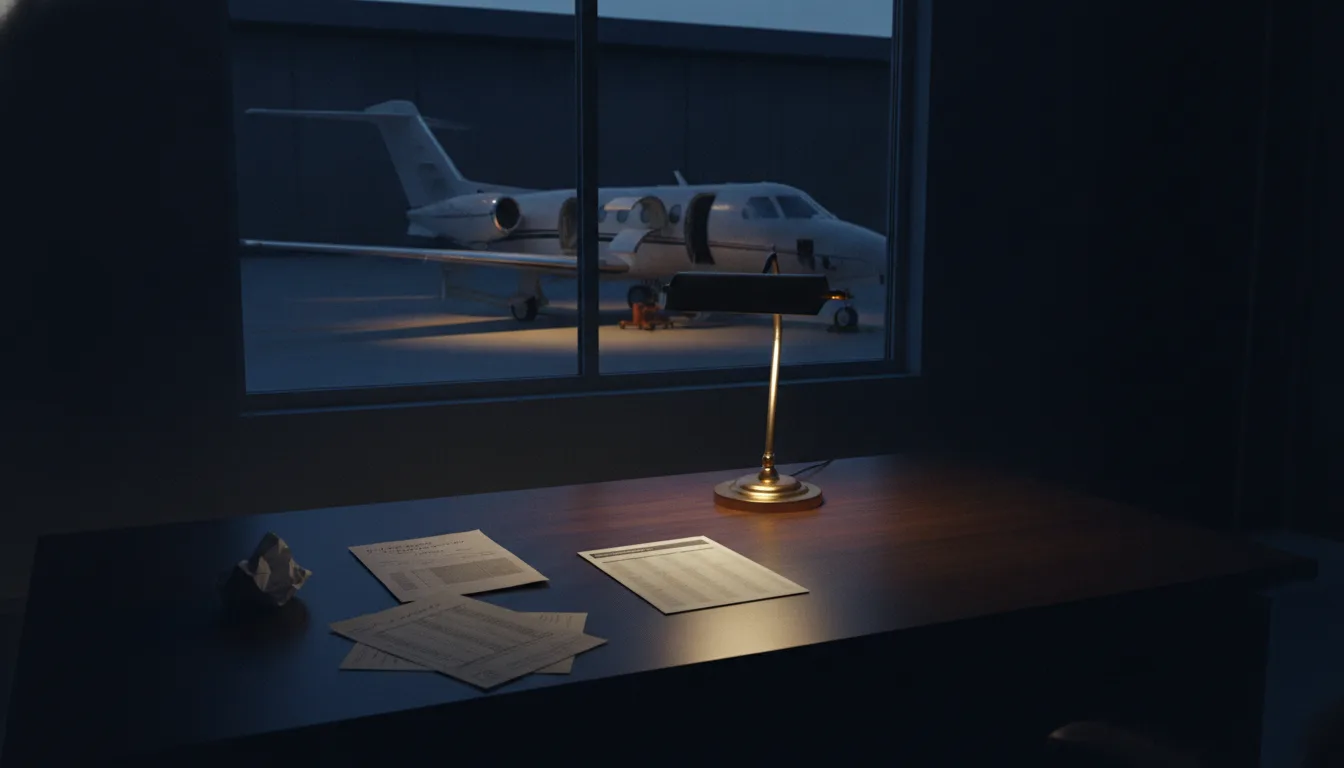
This article is about our own product, so read it with the skepticism that deserves. We have tried to earn some of it back by being specific, including about the places where this process is slower or less impressive than a marketing page would suggest.
The situation
A Citation 560 Encore, based in the southeast, Part 91, flown around 180 hours a year by an owner who intends to keep it for the foreseeable future. Phase 5 is coming due.
On the 550 and 560 series, Phase 5 is the heaviest event in the routine cycle and runs on roughly a three year clock. One Citation shop describes it plainly as the event where surprise scope tends to surface, which is a fair warning and a useful thing to have in mind before anyone signs anything. Phases 1 through 4 carry the lighter recurring items across the nose and cockpit, the gear and empennage, the tail cone, and the engines. Phase 5 is the comprehensive airframe inspection that sits underneath all of it.
The incumbent shop has quoted $312,000 across fourteen pages. The chief of staff forwards it on Tuesday morning with three words: does this look right?
Here is everything that happens between that email and the aircraft going into a hangar.
Stage one: you send us the quote
Forward the email or upload the PDF. That is the entire ask.
Beyond the document itself we need four things: the tail number, access to the current maintenance status or the tracking export, the delivery window you need to hit, and one question that matters more than any other input in the process.
Would you move the aircraft?
That single answer determines the size of the market you are shopping. An operator who will only use facilities within ferry range of home base is shopping a handful of shops. An operator willing to reposition for a heavy event, which is a routine decision on a Phase 5 with a multi week downtime already baked in, is shopping a genuinely competitive field. Neither answer is wrong. They produce very different results and we would rather know at the start.
What you do not do at this stage: retype anything, build a specification, learn what a request for quote is supposed to contain, or make any decision at all.
Stage two: we read it and turn it into a scope
This is where the real work sits, and it is less glamorous than it sounds.
First we separate the quote into the three categories: what is firm, what is estimated, and what is a placeholder standing in for work nobody has defined. On a Phase 5 the placeholder share is usually substantial, because that is the honest nature of the event rather than a flaw in the quote.
Then we work out what is actually being bought, which is harder than it should be. A shop quote is organized the way that shop's system exports it, not the way a scope of work ought to be written. Two shops can quote the same inspection and produce documents that share almost no structure in common.
From that we build a written scope containing the task list, the stated inclusions, the stated exclusions, the schedule window, and the commercial terms that will be quoted rather than assumed. Those terms are the ones from our invoice article: the consumables basis and cap, the parts markup percentage and the threshold above which the shop comes back to you, the handling fee on outside services, and the overtime approval policy.
The scope also specifies how findings will be handled, because that is a commercial term and not a courtesy. Every discrepancy gets an estimated man hour figure. Each one gets approved or denied individually. Nobody carries open ended troubleshooting authority. Shops quote against that protocol, which means you find out at bid time which facilities are comfortable working that way.
Then we come back to you with questions. Usually two or three, and usually about intent rather than engineering. Do you want the interior removal and reinstallation priced as a separate line? Is there any chance this aircraft is sold within two years? That second question quietly rewrites the serviceable versus overhauled logic on every rotable in the package, and almost nobody thinks to raise it.
Stage three: the request goes out
The same document, to qualified Part 145 facilities holding the capability and rating for the type, within the geography you agreed to.
Your incumbent is included unless you tell us not to, and we will actively encourage including them. This is worth stating clearly because operators often assume the point of the exercise is to replace their shop. It usually is not. A shop that has been doing good work at fair prices should be given the chance to demonstrate that, and most of them are glad to.
What bidding shops see, and what they do not
What the bidding shops see: the scope, the type, the timing window, and the terms they are being asked to quote. What they do not see: each other, your identity unless you choose to disclose it, and the number your incumbent quoted.
That last exclusion matters in both directions. A shop that knows the number to beat will beat it by a small margin and stop there, which produces a worse result for you than genuine blind pricing. A shop that does not know the number has to quote what the work is actually worth to them.
Stage four: bids come back and we transcribe them
This is the least impressive step in the process and it is the one that does most of the work.
Shops respond the way shops respond. One sends a formatted PDF. One sends a spreadsheet. One sends an email with a number in the body and a promise to follow up with detail. One calls. We do not require anybody to adopt a portal, learn a system, or change how their estimating department operates, because insisting that suppliers adopt your process is the most reliable way to kill a marketplace before it starts.
So we transcribe. Every response gets normalized onto the same axes: base scope price, labor rates by discipline, projected hours, consumables basis, parts markup, handling fee on outside services, tax treatment, freight, schedule window, findings protocol, and warranty on parts and workmanship.
The output is a single comparison in which every column means the same thing in every row. That sounds trivial and it is the entire product. Four quotes in four formats is not a comparison. It is four documents and an afternoon you will not get back.
Stage five: you choose
You get three things: the comparison, our read on it, and the flags.
The read includes where the numbers sit against what we have seen on comparable scopes, with the sample size stated. If we have four comparable bids we will say four. If we do not have enough comparable data on your type to say anything useful, that is what you will hear, because a benchmark you cannot trust is worse than no benchmark at all.
The flags are the things that are not visible in a price column. A schedule window that looks firm but is not. A scope with an exclusion the others do not have. A rate structure that is competitive on straight time and expensive on overtime, which matters enormously on an event where overtime is likely. We will tell you when the cheapest bid is not the one we would take, and we will tell you why.
We do not make the decision. Your director of maintenance does, and should. They know the aircraft, they know which shops have treated them well, and they carry the responsibility for the outcome.
Stage six: award and coordination
One point here is worth more than the rest of this section combined.
The terms you were quoted on are the terms that go into the work authorization.
That sounds too obvious to state. It is also the single most common place where a competitive process quietly leaks everything it gained. The price was competed, everyone congratulated themselves, and then the work authorization that got signed carried the shop's standard terms: the standard consumables percentage, the standard markup, the standard silence on overtime approval. The event then bills the way it was always going to bill, and the competitive exercise turns out to have been decorative.
What this actually costs you in effort
The honest accounting, because effort is the real reason competitive sourcing does not happen.
| Stage | What you actually do | Your time |
|---|---|---|
| Send the quote | Forward the email or upload the PDF | About 10 minutes |
| Answer scoping questions | Two or three questions, usually about intent rather than technical detail | About 15 minutes |
| Review the comparison | Read one document in which every column means the same thing in every row | About 30 minutes |
| Decide | Talk it through with your DOM | Your call |
| Award | Sign one work authorization carrying the terms you were quoted on | About 10 minutes |
| Total of your time | Roughly one hour, spread across the process |
Compare that to running it yourself. The first quote costs four minutes because it arrives on its own. Every additional one costs the call, the follow up call, the scope clarification, the chasing, and then the transcription into some format where the four of them can sit next to each other. That is not an hour. That is most of a week of a competent person's attention, distributed in the most disruptive way possible across other work.
What we are honest about
Five things, and they are the reason this article exists rather than a features page.
- It takes time. If your aircraft is due in a hangar in six days, this is the wrong process and we will say so rather than take the engagement. Competitive sourcing needs runway, and a rushed request produces bad bids from shops who did not have time to read the scope properly.
- It does not always save money. Sometimes the incumbent was already sharp and the comparison confirms it. That is a legitimate outcome and, as we have argued elsewhere, a genuinely valuable one, but nobody should engage expecting a discount as a guarantee.
- Coverage is uneven by type. Common airframes with deep shop networks produce rich comparisons. Rarer types produce thinner ones, and on some aircraft the honest answer is that there are only two credible facilities and you already know both of them.
- We are not a repair station and we do not perform maintenance. We do not decide what work your aircraft needs, we do not overrule your DOM, and we do not second guess a technician's engineering judgment from a desk.
- The first event is more work than the ones after it. Once a scope exists for your aircraft and your type, it becomes a template, and the second Phase 5 costs a fraction of the effort of the first.
The same mechanism runs for parts
Everything above describes a scheduled maintenance event, which is the version with time to think. The identical structure runs on parts, including under AOG pressure, where the request goes out to the supplier pool in parallel rather than to one broker in sequence, and the responses come back on the axes that actually matter: condition, tag and issuing authority, physical location, realistic time to airworthy, landed cost, and core terms.
The difference is the clock. On a Phase 5 you have weeks. On an AOG you have hours, which is precisely when nobody has time to shop and precisely when the price discipline is worth the most.
Send us a quote
If you have a quote sitting in your inbox right now that you were planning to approve because approving it is easier than interrogating it, that is the one to send.
We will read it, structure it, take it to market, and hand you back something you can actually decide from. And if it comes back in range, we will tell you that too, which is a decent outcome and more common than you might expect.
Sources and further reading: AOPA, aircraft inspection program guidance on Citation phase structure and intervals. Published Citation maintenance capability documentation on 550 and 560 series phase inspections and typical downtime. Brian Wells, Jet Support Services Inc., AvBuyer, on maintenance debriefs, discrepancy approval, and invoice review. Duncan Aviation, guidance on comparing maintenance quotes.
See for yourself
One hour of your time. A market's worth of leverage.
Forward your next maintenance quote and our team will structure it, take it to bid, and hand back a comparison you can actually decide from.