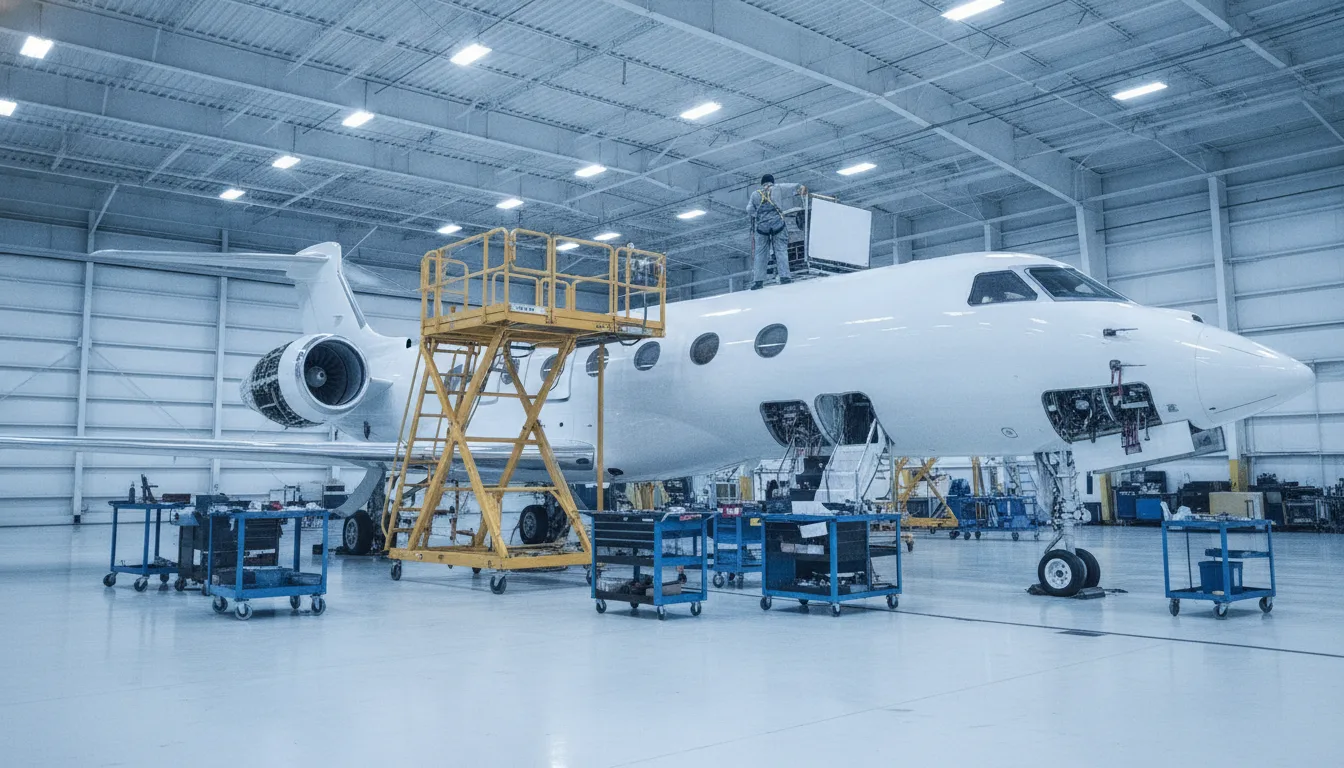
A Starlink installation takes somewhere between ten and twenty-five days depending on the airframe and the shop. If you schedule it on its own, you pay every one of those days. If you schedule it into an inspection the aircraft is already down for, most of them cost you nothing extra, because the aircraft was not flying anyway. That sequencing decision is usually worth more than anything you will negotiate on price.
Almost nobody plans it this way, because connectivity gets treated as an avionics purchase rather than a maintenance event. It is a maintenance event. Here is how to run it as one.
What the downtime actually looks like
Reported installation downtime clusters in two bands. Shops running efficient single-type programs, meaning they do the same airframe repeatedly and have the process refined, report roughly 10 to 14 days. Shops covering a broader range of large-cabin airframes report 15 to 25 days depending on the aircraft.
Both are honest numbers. The difference is repetition, not competence. A shop on its twelfth Challenger 350 knows where the wire runs and what the structural review will say. A shop on its first is discovering it on your aircraft and on your clock.
The number that decides your answer
Whatever your operation values a day of unavailability at, multiply it by fifteen. For most operators that figure rivals or exceeds the hardware. It is also the figure that never appears on any quote.
Incremental versus concurrent downtime
This is the whole idea, and it is simple once stated.
Incremental downtime is time the aircraft is unavailable purely because of this project. You induct for the installation, you wait, you take delivery. Every day is a day the aircraft would otherwise have been flying.
Concurrent downtime is time the aircraft was already going to be down. The inspection is due. The aircraft is in the hangar, opened up, with panels off and interior partially out. Work that happens inside that window costs you calendar days you had already written off.
The installation does not get faster when you combine it. Your unavailability does. Those are different numbers, and only one of them is on your schedule.
The saving is not usually the entire install. There is almost always some incremental tail, because the connectivity work has steps the inspection does not cover and the two do not perfectly overlap. But converting the bulk of two weeks from incremental to concurrent is the largest single lever in this decision, and it is available to any operator with an inspection on the horizon.
Why it also lowers the invoice, not just the calendar
Sequencing saves money in four separate places, and they compound.
- One induction instead of two. Getting an aircraft into a shop has fixed costs that have nothing to do with the work: intake inspection, records review, setup, and the administrative overhead of opening an event. Doing it once rather than twice removes a whole layer.
- One ferry instead of two. If the shop is not on your field, you are positioning the aircraft twice for two separate events, with crew time and fuel on both legs.
- Shared access. Interior panels, headliner sections, and floor access that the installation would require may already be off for the inspection. Labor you would otherwise pay for twice is paid once. This is real money on a large cabin.
- Better pricing on the package. Shops quote a combined event differently than a standalone installation, because their own scheduling economics improve. You are filling a slot they already committed to your aircraft.
When it does not work
Being honest about the limits, because the answer is not always yes.
- The inspection is too far out. If your next due event is fourteen months away, waiting for it costs you fourteen months of not having the system, and for many operators that is the wrong trade. Particularly relevant if you are making a decision under a deadline like the August 2026 repricing or the Viasat Ku sunset.
- The shop that does your inspection cannot do the installation. Dealer authorization and STC coverage for your airframe are two separate things, and both have to be true at the same facility. Your usual inspection shop may hold neither. Sometimes the right answer is to move the inspection to a shop that can do both, and sometimes it is not worth it.
- The inspection is already a large unknown. Stacking a modification onto an event with substantial expected findings can make both harder to manage and turns one schedule risk into two. If you are anticipating significant discovery, sequencing them separately may be the calmer choice.
- Capacity does not line up. The slot you can get for a combined event may be later than the two separate slots. In a quarter when installer capacity is tight, this happens more than you would expect.
How to actually set it up
Start from the due list, not from the quote
Before you ask anyone what an installation costs, know what is coming due and when. Inspections, life-limited items, and any deferred work you have been carrying. That list is the frame the whole decision sits in, and it is the thing that determines whether concurrent sequencing is even available to you.
Scope both together, in one document
Send the inspection scope and the installation scope to shops as one package and ask to be quoted that way. You want to see, explicitly:
- Total downtime for the combined event, stated as a number of days
- What that same downtime would be if the two were done separately
- Which access and labor is shared between the two scopes
- One induction date and one delivery date
- How findings from the inspection will be handled without silently eating the installation schedule
That fourth bullet is where combined events go wrong. An inspection generates discrepancies by design, and if nobody agrees in advance how discovery gets approved and sequenced, the installation ends up waiting on a part for a completely unrelated squawk.
Get the discrepancy process in writing before induction
Every finding quoted individually with a man-hour estimate, approved by you before work starts, and a work-in-progress report at least every two weeks showing hours expended against each task. This is standard practice on any heavy event and it matters more when two scopes are sharing a hangar slot. We covered how to read that kind of quote line by line here.
The ordering question
One practical detail worth raising with the shop: within a combined event, when does the connectivity work happen?
Doing structural and wiring work while the aircraft is already opened up for the inspection is the entire point. But the functional checkout of the connectivity system wants to happen late, once the aircraft is buttoned up and back on power. A shop that has done this before will sequence it without being asked. A shop that has not may treat the two scopes as sequential projects sharing a building, which recovers far less of the saving than you were promised.
Ask how they intend to interleave the two. The quality of that answer tells you how many combined events they have actually run.
What this looks like as a decision
| Your situation | Usually the right move |
|---|---|
| Inspection due within about six months | Combine. This is the clearest case. |
| Inspection due in 6 to 12 months, no deadline pressure | Combine, and price both now so the slot is held. |
| Inspection more than a year out | Usually install standalone, unless downtime is unusually cheap for you. |
| Under a service or migration deadline | Deadline wins. Sequence around it, do not wait for the inspection. |
| Inspection shop cannot install | Price both paths. Moving the inspection is sometimes worth it and sometimes not. |
| Heavy findings expected | Consider separating, to keep one schedule risk from becoming two. |
Where we come in
This is precisely the sequencing question a maintenance control desk should be answering, and most owners do not have one. Send us your due list along with the connectivity requirement and we will scope them together, put the combined package out to qualified shops, and bring back quotes that state the combined downtime, the separate downtime, and the slot date for each.
Frequently the shop with the best installation price is not the shop with the best combined answer, and you cannot see that without pricing both.
Send us the aircraft and your due list, or read more about how the quoting process works.
Note on figures: installation downtime bands reflect reported ranges across shops as of July 9, 2026 and vary by airframe, by approval path, and by how many of your type a given facility has completed. Treat them as planning ranges, not quotes.
Virtual Hangar is not a repair station and does not perform installations or inspections. We scope the work, run the competition, and coordinate the event. The work is performed by the certificated facility you select, and your agreement is with them.
Sequence it properly
Price the installation and your due list together
One scope covering both, quoted by shops that can do both, with the combined downtime stated in days.